Last updated: 3 November 2026, 2:52pm AEDT
The short answer: The Reserve Bank raised the cash rate by 0.25% today to 4.85%, its fifth rise in 2026. If you have a variable home loan and your lender passes the rise on in full, your repayments will go up, usually within a couple of weeks.
An interest rate rise is never welcome news, but knowing what changes, and when, makes it easier to plan. Here's what today's decision means for your repayments, what the banks and economists expect next, and some practical steps if you're buying your first home or thinking about refinancing.
The RBA rate decision: what happened today and why
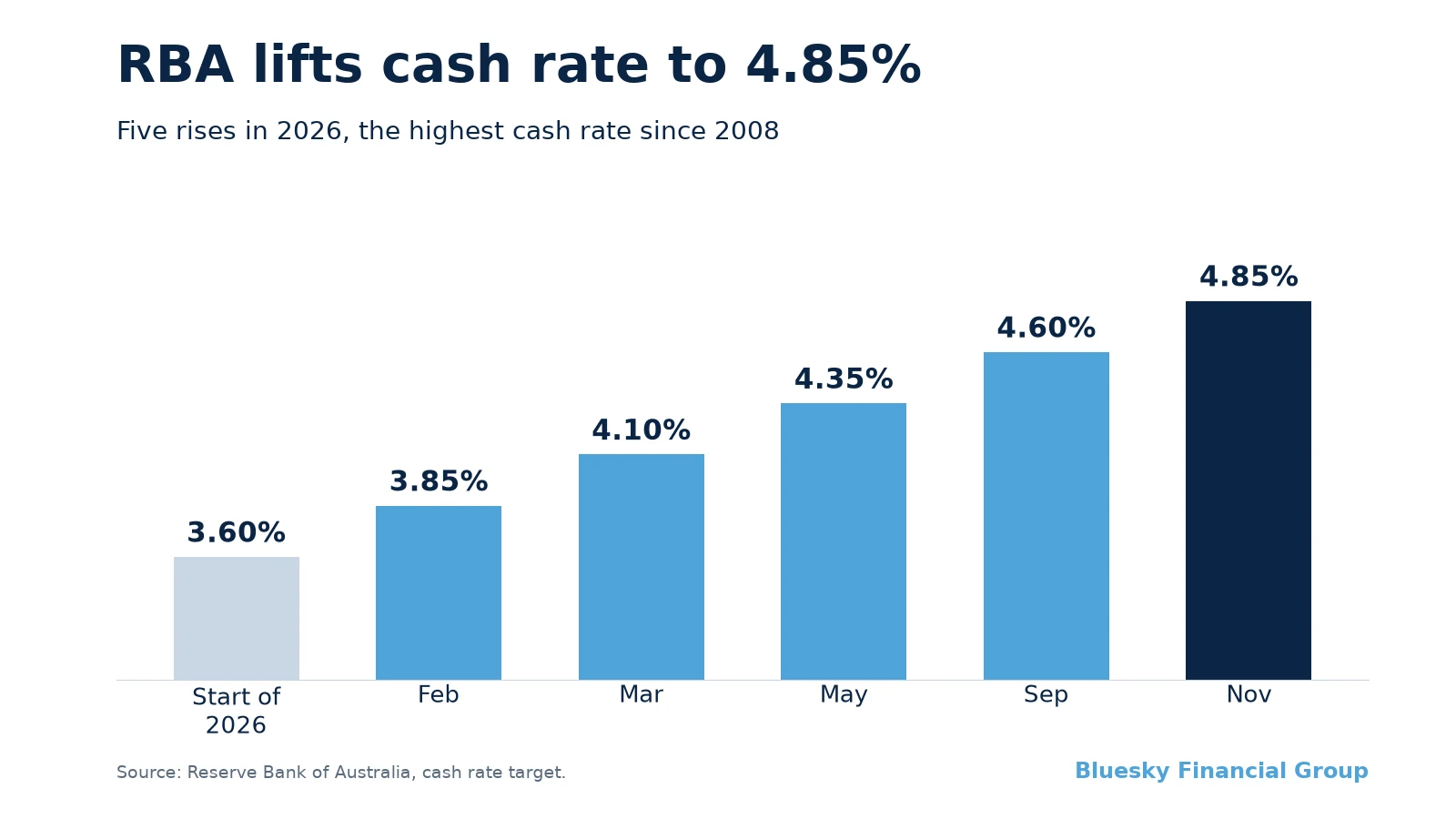
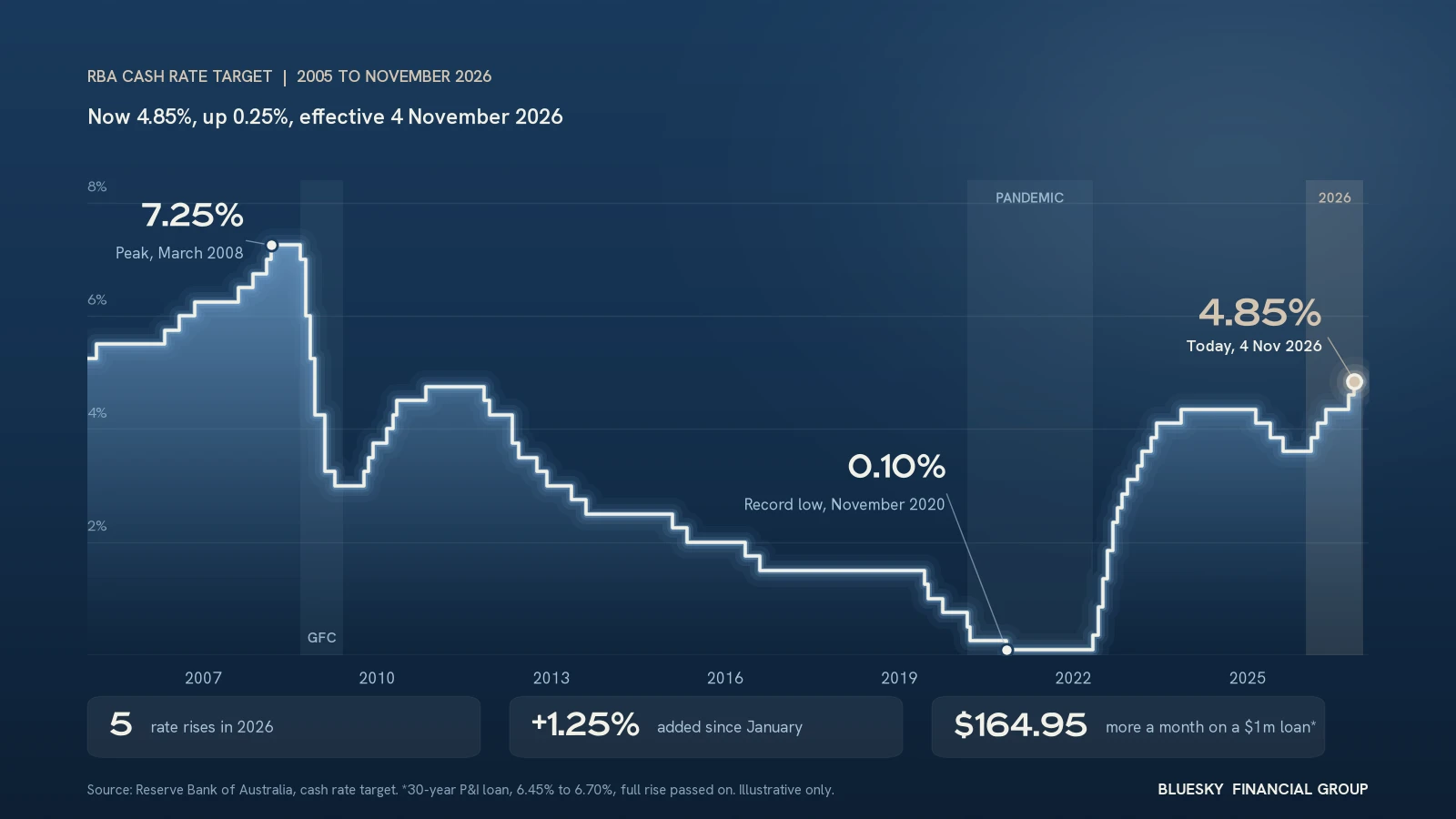
The RBA cash rate had been 4.60% since 30 September 2026. Today's rise takes it to 4.85%, the highest level since 2008. You can read the RBA's media release. It's the fifth rise this year, after February (3.85%), March (4.10%), May (4.35%) and September (4.60%), with holds in June and August.
The main reason is inflation. Headline inflation was 4.3% for the 12 months to September. The trimmed mean, a different measure that strips out the biggest price swings and that the RBA watches closely, rose 1.0% in the September quarter, or 3.7% over the year to September (3.6% on the monthly measure). Unemployment is 4.7%.
In the lead-up, Governor Michele Bullock told a Senate committee on 28 October that some upside risks had materialised and the labour market was "a little tighter than we had previously judged". Deputy Governor Andrew Hauser said on 21 October that the inflation outlook was "materially worse".
How much will my mortgage repayments go up?
Here's what a 0.25% rise could mean on a 30-year principal and interest loan, if a variable rate goes from 6.45% to 6.70% and your lender passes the full rise on. We've used 6.45% because the RBA's average owner-occupier variable rate was 6.2% in August 2026 (RBA table F6), and September's 0.25% rise was passed on after that.
| Loan amount | Monthly repayment at 6.45% | Monthly repayment at 6.70% | Increase per month | Increase per year (approx.) |
|---|---|---|---|---|
| $750,000 | $4,715.88 | $4,839.58 | $123.71 | $1,485 |
| $1,000,000 | $6,287.83 | $6,452.78 | $164.95 | $1,979 |
| $1,500,000 | $9,431.75 | $9,679.17 | $247.42 | $2,969 |
How this is calculated: monthly repayment = loan amount × monthly rate ÷ (1 − (1 + monthly rate) to the power of −360). The monthly rate is the annual rate divided by 12, and 360 is the number of monthly repayments over 30 years.
These are examples for illustrative purposes only. This is not a quote or financial advice. Your own figures depend on your individual circumstances including rate, loan balance, remaining term and loan type. Interest-only loans and loans with a shorter remaining term will move differently.
When will my bank pass on the rate rise?
Lenders set their own timing. After the September rise, all four major banks passed it on in full from 9 October, about 10 days after the decision. Your lender should write to you with your new repayment amount before it starts.
If you're on a fixed rate, your rate and repayments won't change until the fixed period ends. It's worth knowing when that date is, because the rate you roll onto may be quite different from the one you have now.
What the experts expect for the RBA interest rate next
All four major banks expected today's rise. Where they differ is on what comes after it.
- CBA: CommBank's Head of Australian Economics, Belinda Allen, called it an "insurance hike" in CommBank's 28 October release, and expects holds in December and February, with cuts pencilled in for August and November 2027, though it says the uncertainty is high. In a 2 November update, it cut its growth forecast to 1% by mid-2027 and said it expects unemployment to peak at 5.1% at the end of 2027.
- Westpac: Westpac Group Chief Economist Luci Ellis says the risk of another rise, most likely in February, has increased.
- NAB expects a pause after November, but says the RBA is "a long way from declaring victory on inflation".
- ANZ economists see a "material risk" that the cash rate reaches 5.10% in December or February, according to The Adviser's report of ANZ's 30 October weekly note.
A Finder survey of 40 experts on 2 November found 30 expected a rise today. 28% expect another after November, mostly in February 2027, and 80% expect the cash rate to be above 4.60% by March 2027.
Some economists are also talking about the risk of a slowdown. AMP Chief Economist Shane Oliver told the Sydney Morning Herald the chance of a recession is 30 to 40%, and HSBC's Chief Economist for Australia, New Zealand and Global Commodities, Paul Bloxham, told the ABC a 2027 recession is a "50:50 chance". In the same ABC report, Betashares Chief Economist David Bassanese said he expects a hold in December. Forecasts change quickly, so treat them as a guide to the range of views rather than a prediction.
First home buyer interest rates: what it means if you are buying

A higher rate usually means a lower borrowing capacity, because lenders test whether you could still afford your repayments if rates rose further. If you got pre-approval before today, it may not stretch as far as it did, so check with your lender or broker before you make an offer or bid at auction.
A rate rise doesn't automatically make now a bad time to buy. It does make it more important to know your real budget and to leave yourself some room. You can read more about how we help first home buyers through pre-approval and beyond.
What it means if you are thinking about refinancing
Lenders often price new customers differently from existing ones, so if you haven't reviewed your rate in a while, you may be paying more than you need to. A rate rise is a good prompt to check.
Refinancing isn't right for everyone. There can be costs to leave your current lender, and a lower borrowing capacity can limit your options. Comparing your current loan with what's available now will show whether a change is worth it. You can read more about our help for refinancers. If you're self-employed, we also explain self-employed home loans, which often require a different approach.
Should I fix my home loan now?
When you weigh up a fixed vs variable home loan, fixing gives you certainty about your repayments for a set period. The trade-off is less flexibility: you may not be able to make extra repayments, and there can be break costs if you sell or refinance early. If rates fall during your fixed period, you won't get the benefit.
Some borrowers choose a split loan, with part fixed and part variable, so they have some certainty and some flexibility. Which option suits you depends on your budget, your plans and how much uncertainty you can comfortably carry. No one knows for sure where rates will go next, so it's worth making the decision on your own situation rather than a forecast.
If you'd like help weighing it up, we offer a complimentary home loan review, where we look at your rate, your loan structure and your plans, and talk you through your options.
Practical steps you can take this week
- Find your current rate. Check your latest statement or banking app and note your rate, balance and remaining term.
- Work out your new repayment. Use the table above as a rough guide, or wait for your lender's letter.
- Look at your budget. Even $120 to $250 more a month adds up. Knowing where it will come from now is easier than finding it later.
- Use your offset or redraw. Money in an offset account reduces the interest you pay.
- Check your pre-approval if you're buying.
- Talk to your lender early if things feel tight. Lenders have hardship options, and it's much easier to arrange help before you miss a repayment.
- Get your loan reviewed by a broker. It can show whether your rate and structure still suit you.
Our view
Rate decisions are outside anyone's control, but your loan structure isn't. Many borrowers are on a rate that hasn't been reviewed since they took the loan out, and lenders price new customers differently from existing ones. A review takes about 30 minutes and tells you whether you're paying more than you need to, whether your pre-approval still stands, and what your options are.
FAQs
How many times has the RBA raised rates in 2026? Five times, including today: February, March, May, September and November.
Does a rate rise affect fixed rate loans? Not during the fixed period. It can affect the rate you move onto when the fixed period ends.
Will my bank pass on the full rise? Each lender decides. After the September rise, all four major banks passed it on in full.
Does a rate rise affect my borrowing capacity? Usually, yes. Higher rates generally mean you can borrow a little less, which can also affect an existing pre-approval.
Will interest rates go up again? Views differ. Westpac sees a risk of another rise in February, while CBA expects holds in December and February and has cuts pencilled in for August and November 2027. No forecast is certain.
Book a free home loan review
If you'd like to know where your loan stands after today's decision, book a free home loan review with Bluesky. We help clients Australia wide, with offices in Byron Bay and Sydney if you'd prefer to meet in person. Our mortgage broker in Byron Bay team looks after clients across the Northern Rivers.
General information only. This information is general in nature and does not take into account your objectives, financial situation or needs. Consider whether it is appropriate for you and seek advice before acting.
Credit services are provided by authorised credit representatives of LMG Broker Services Pty Ltd ACN 632 405 504 (Australian Credit Licence 517192).